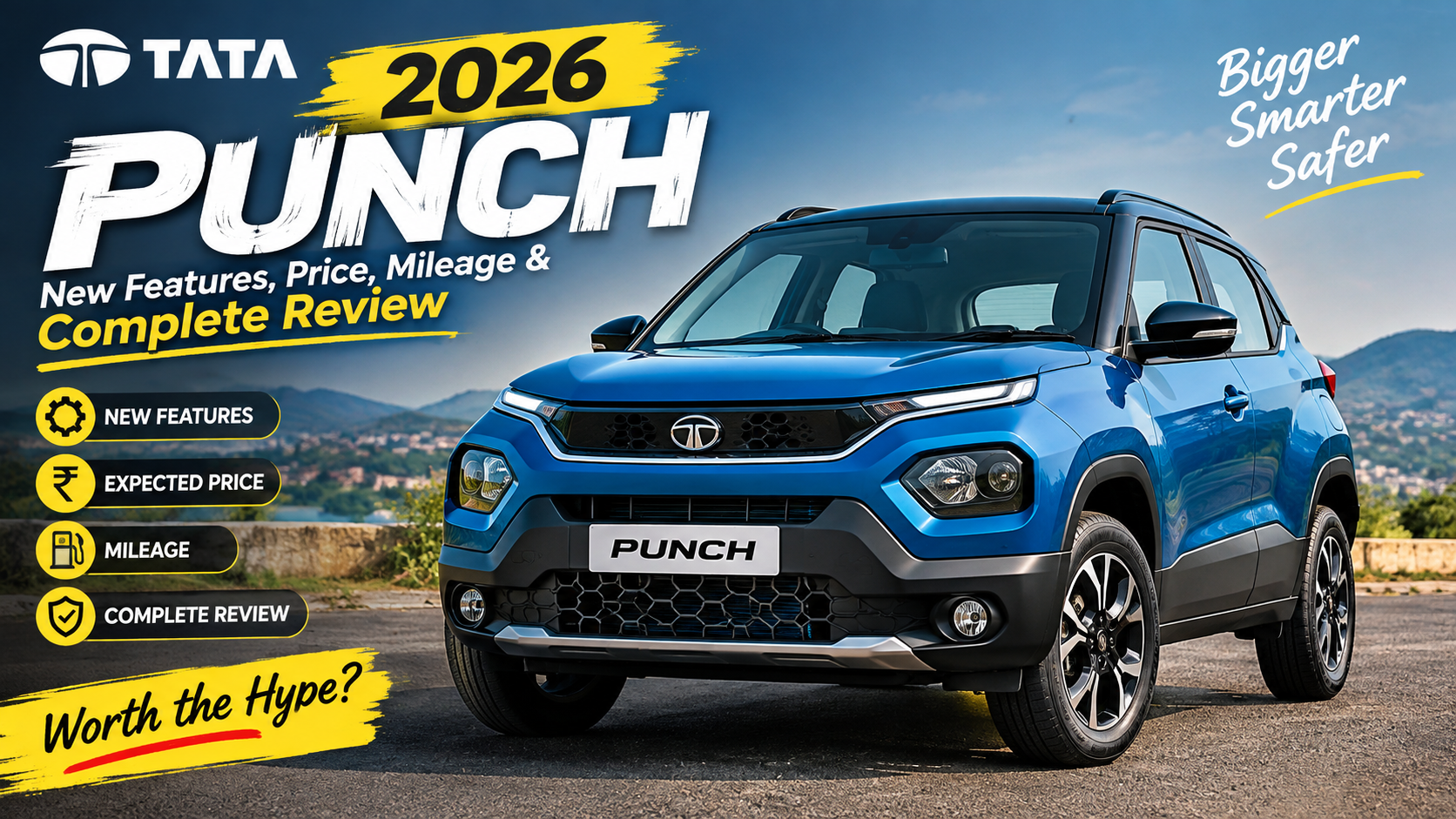
The Indian car market has plenty of SUVs, but finding one that fits a family budget without compromising on practicality is not always easy. This is where the Tata Punch makes a strong case for itself. With its compact dimensions, high ground clearance, modern features and safety-focused design, the Punch has become a popular choice among buyers looking for an affordable SUV for everyday use.
For 2026, Tata Motors has updated the Punch with a refreshed design, additional technology and a new turbo-petrol engine option. The latest model aims to appeal to both first-time car buyers and people upgrading from a small hatchback.
But is the new Tata Punch actually worth buying? How much does it cost, what mileage can you expect, and which variant makes the most sense? Let’s take a closer look.
2026 Tata Punch Price in India
Price is one of the biggest reasons buyers consider the Tata Punch. The 2026 facelift starts at approximately ₹5.75 lakh ex-showroom, while the top-end variant costs around ₹10.77 lakh, depending on the variant and powertrain.
Here is a quick overview of the price range.
| Variant or option | Approx. ex-showroom price |
|---|---|
| Tata Punch Smart Petrol | ₹5.75 lakh |
| Tata Punch Pure Petrol | Around ₹6.65 lakh |
| Tata Punch Pure Plus Petrol | Around ₹7 lakh |
| Tata Punch Petrol AMT | Around ₹7.50 lakh onwards |
| Tata Punch CNG | Around ₹6.70 lakh onwards |
| Tata Punch Turbo Petrol | Around ₹8.50 lakh onwards |
| Tata Punch Top Variant | Up to ₹10.77 lakh |
Prices are indicative and may vary by variant, location and current offers. Check the latest price list with your local Tata Motors dealership before booking.
The base variant is suitable for buyers who want an affordable vehicle for regular commuting. However, if you want a touchscreen infotainment system, additional convenience features and a more premium cabin experience, the mid-range variants deserve a closer look.
The higher variants are more appealing to buyers who want a feature-rich SUV with additional technology. Remember that the final on-road price will be higher than the ex-showroom price because it includes registration, insurance and applicable charges.
For example, a base model priced at ₹5.75 lakh ex-showroom could cost approximately ₹6.30–₹6.80 lakh on-road, depending on the city and insurance package. This is only an estimate, not a confirmed dealer quotation.
2026 Tata Punch New Design: What Has Changed?
The Tata Punch already had a distinctive SUV-inspired appearance, and the 2026 update builds on that identity. The facelift brings styling changes that make the vehicle look more modern and closer to Tata’s newer SUV family.
At the front, the updated lighting arrangement and revised bumper give the Punch a fresher appearance. The design looks more upright and purposeful, which suits the SUV character of the vehicle.
The compact proportions remain useful for Indian roads. In crowded markets, narrow residential streets and busy parking areas, a smaller SUV can be much easier to handle than a larger vehicle.
The side profile retains the Punch’s high stance and practical body shape. Its ground clearance is particularly useful when driving over speed breakers, uneven roads and broken patches of tarmac.
At the rear, updated styling details help the facelift look more contemporary. Alloy wheel designs and exterior colour choices can also influence how premium the car looks, depending on the selected variant.
Overall, the design changes are evolutionary rather than a complete transformation. Tata has focused on making an already familiar product look fresher while retaining the proportions that made it popular.
Interior and Cabin Experience
The cabin is an important part of the Punch’s appeal because many buyers will use it as their primary family car.
The driving position provides a relatively high view of the road, which can make navigating traffic feel more comfortable. The compact dashboard layout and upright seating position also help create the impression of sitting in a small SUV rather than a conventional hatchback.
Higher variants offer a more modern experience through their infotainment and driver-display technology. Depending on the trim, buyers can get features such as a touchscreen infotainment system, a digital instrument display, steering-mounted controls and connected smartphone functionality.
The touchscreen interface is particularly useful for navigation, music and hands-free smartphone access. Wireless connectivity, where provided, can make daily use more convenient by reducing the need to connect a cable every time you enter the car.
Cabin storage and everyday practicality remain important strengths. There is space for small personal items, bottles and other essentials, although the usefulness of individual storage areas depends on how many passengers are travelling.
The rear seat is suitable for everyday family journeys, but buyers should not expect the same level of space as a larger compact SUV. Three adults sitting in the rear may find the shoulder room restrictive, especially on longer trips.
Before making a purchase, sit in both the front and rear seats during a dealership visit. Check the headroom, legroom, seat cushioning and ease of getting in and out. These details often matter more in daily ownership than a long list of specifications.
Engine and Performance
One of the major highlights of the 2026 Tata Punch is the wider choice of powertrains.
1.2-litre naturally aspirated petrol engine
The standard petrol engine is designed primarily for everyday driving. It produces approximately 88 PS and 115 Nm of torque, paired with a manual gearbox or an AMT automatic, depending on the variant.
For city commuting, this engine should be adequate for normal traffic conditions. It is a sensible choice for buyers who prioritise affordability, straightforward driving and regular family use over outright acceleration.
However, a naturally aspirated engine in a compact SUV is not designed to deliver sports-car performance. When the vehicle is fully loaded or travelling uphill, you may need to use the gearbox more actively to maintain momentum.
1.2-litre turbo-petrol engine
The facelift also introduces a more powerful turbo-petrol option. This engine is rated at approximately 120 PS and 170 Nm, giving the Punch a noticeable performance advantage on paper.
The additional power should be useful when overtaking, joining faster roads or driving on highways. Buyers who frequently travel outside the city may find the turbo-petrol version more appealing.
The turbo engine is generally paired with a manual transmission, so check the available combinations for your preferred variant before booking.
CNG option
The factory-fitted CNG version is aimed at buyers who cover significant distances and want to reduce fuel expenses.
A dual-cylinder arrangement helps preserve some luggage space compared with a traditional large CNG cylinder layout. Even so, the available boot space and loading flexibility should be checked in person.
The right engine depends on your driving habits. For everyday city use, the standard petrol engine is a practical option. For a tighter fuel budget, consider CNG. For stronger acceleration, the turbo-petrol version is worth evaluating.
2026 Tata Punch Mileage
Mileage is another important factor, particularly for buyers who commute daily.
The standard petrol version has a reported claimed fuel-efficiency figure of around 20.09 km/l, although the exact figure can vary with the engine, transmission and variant. CNG offers a different cost-per-kilometre advantage, while the turbo-petrol engine prioritises performance.
Here is what buyers should understand before relying on mileage figures.
Petrol mileage: The advertised figure is generally obtained under controlled testing conditions. Actual fuel efficiency depends on traffic, road quality, air-conditioning use, driving style and vehicle load.
CNG efficiency: CNG can be economical for drivers who cover long daily distances. However, savings depend on local CNG prices and the availability of filling stations along your regular route.
Highway mileage: Steady driving can improve fuel efficiency compared with frequent stop-and-go traffic, but speed, road gradients and the number of passengers still make a difference.
For a realistic ownership estimate, calculate fuel costs using your daily distance and the mileage you actually achieve. A test drive over your usual route can also help you understand how the car behaves in local traffic.
Features and Technology
The 2026 Punch facelift brings a more contemporary equipment package, especially in the higher trims.
Depending on the variant, notable features include:
- Touchscreen infotainment system
- Digital instrument display
- Smartphone connectivity
- Automatic climate control on selected variants
- Electric sunroof on selected variants
- 360-degree camera on selected variants
- Rear parking camera and sensors, depending on trim
- Cruise control on selected variants
- Steering-mounted controls
- Connected-car functions and convenience features, where equipped
The availability of individual features varies across the range, so it is important not to assume that the base model includes everything advertised for the Punch.
The 360-degree camera can be especially helpful in tight parking spaces. Similarly, a sunroof and digital display can make the cabin feel more premium, although neither is essential for every buyer.
My advice is to shortlist features that will genuinely improve your everyday driving experience. A useful camera, comfortable seating and good smartphone connectivity may be more valuable than a feature you rarely use.
Safety: One of the Punch’s Strongest Selling Points
Safety has played a major role in the Punch’s reputation. Its compact size does not mean buyers should overlook structural protection, braking performance or driver-assistance equipment.
The car’s safety package varies by variant, but equipment can include multiple airbags, ABS with EBD, electronic stability control, hill-hold assistance, rear parking sensors and a rear-view camera. Check the exact specification of the variant you intend to purchase.
The 2026 facelift also brings attention to advanced driver-assistance technology and related equipment. However, buyers should confirm which systems are actually fitted to the chosen trim rather than assuming every advertised technology is standard.
It is equally important to distinguish between a model’s earlier crash-test rating and the safety performance of a facelifted version. A previous rating should not automatically be treated as a new, independent crash-test result for every updated configuration.
For family buyers, safety should be assessed alongside the seating position, visibility, braking feel and availability of essential safety features in the chosen variant.
Ride Quality and Everyday Driving
Indian roads can be unpredictable. One street may have smooth tarmac, while the next has potholes, uneven surfaces or tall speed breakers. The Punch’s SUV-style stance and approximately 193 mm of ground clearance are useful in these conditions.
Its compact size is an advantage in urban areas. U-turns, narrow lanes and parking in busy markets are generally easier to manage in a small vehicle than in a large SUV.
The suspension is intended to handle everyday road conditions, although ride comfort will depend on road quality, tyre pressure, speed and the number of passengers.
On highways, the naturally aspirated engine is better suited to relaxed driving than aggressive overtaking. The turbo-petrol version offers a stronger performance alternative for drivers who want more power.
Before buying, take a proper test drive on both smooth roads and uneven surfaces. Pay attention to suspension noise, steering response, braking confidence and how comfortable the seats feel after 20–30 minutes.
Tata Punch vs Its Rivals
The Punch competes with cars such as the Hyundai Exter and other similarly priced compact vehicles. Depending on the budget and variant, buyers may also consider the Nissan Magnite and Renault Kiger.
The Tata Punch makes sense for people who want an upright driving position, compact dimensions, a choice of petrol and CNG powertrains, and a strong focus on safety.
The Hyundai Exter is worth comparing if its equipment package, cabin layout or ownership experience appeals to you. The Magnite and Kiger are alternatives for buyers who want to compare turbo-petrol performance and SUV styling.
There is no single best car for every buyer. Compare the variants at similar prices rather than comparing the base Punch with a fully equipped rival. A dealership test drive and a detailed on-road quotation will provide a more meaningful comparison.
Pros and Cons of the 2026 Tata Punch
What works well
- Compact dimensions make city driving easier.
- High ground clearance is useful on uneven roads.
- Petrol, turbo-petrol and CNG options provide flexibility.
- The facelift adds modern design and technology.
- Higher variants offer useful convenience features.
- The starting price makes the Punch accessible to many buyers.
What could be better
- Rear-seat space may feel limited for three adults.
- The standard petrol engine is not intended for spirited performance.
- Feature availability differs significantly between variants.
- The on-road price can rise considerably above the advertised starting price.
- Actual mileage will depend on driving conditions and usage.
- Buyers should verify the exact safety and technology package before booking.
Which Tata Punch Variant Should You Buy?
The best variant depends on your budget and how you plan to use the car.
For budget-conscious buyers: The base petrol variant is worth considering if your priorities are affordability and everyday transport.
For most families: A mid-range variant may offer a better balance of convenience, technology and price. Compare the additional features against the actual difference in on-road cost.
For automatic convenience: Consider an AMT-equipped version if your regular route includes heavy traffic. Take a test drive first to see whether its gear changes suit your driving style.
For lower running costs: The CNG variant deserves attention if you travel long distances regularly and have convenient access to CNG stations.
For performance-focused buyers: The turbo-petrol version is the more interesting choice if stronger acceleration matters to you. Budget for its higher purchase price and potentially different fuel costs.
Final Verdict: Is the 2026 Tata Punch Worth Buying?
The 2026 Tata Punch continues to make a convincing case for buyers who want an affordable, compact SUV for daily use. Its refreshed styling, multiple powertrain choices, practical ground clearance and updated features make it a vehicle worth considering in the Indian market.
The standard petrol version should suit buyers who mainly drive in the city, while the CNG option can appeal to people who want to manage their running expenses. The new turbo-petrol engine adds another dimension for those who want stronger performance.
However, the Punch is not perfect. Rear-seat space, the performance of the standard engine and the price difference between variants deserve careful consideration. Buyers should also verify the equipment included in their chosen trim instead of relying only on the top model’s feature list.
At an indicative ex-showroom price of ₹5.75 lakh to ₹10.77 lakh, the Punch covers a broad range of budgets. The actual value depends on the variant, local on-road price and the features you genuinely need.
If you are looking for a compact family car with SUV styling, useful ground clearance and a choice of petrol and CNG powertrains, the 2026 Tata Punch deserves a place on your shortlist. Take a test drive, compare two or three variants and check the final dealer quotation before making your decision.